Elder Kwizera is the very last of our “hold over” missionaries to return home. He is the only missionary in the world serving from the country of Burundi. Borders to his country have finally opened and he can go home! This week Elder Kwizera turned 27 years old and this week he entered his 32nd month of missionary service here! He has been patient and steadfast, enduring many hardships since COVID began, including having tuberculosis. We are grateful he is finally able to return to his home in Burundi. Tonight we celebrated his missionary service with a Burger King feast! It’s safer to eat at home than to be out during these election times.
We expect great things from Elder Kwizera in Burundi. We send him off with our greatest respect and love.
What do you do on a Friday evening during a lock down?? YOU MAKE TACOS!!! We had a great evening with the Bendixsens with some delicious food and then we watched the movie, Ben Hur, a first for them. It was so fun.
Our missionaries in both missions are still in their apartments here in the Abidjan area, staying inside. One of our apartments has 20 missionaries in it. These are challenging times. Every day we check the news and reports from members in the different areas to get a feel for the pulse out there. There are demonstrations happening here and there, some are dangerous. We are keeping our missionaries safe, but they are getting a little stir crazy. We’ve also spent way more time in our apartment this week, going to the office only when really necessary. Tonight was a nice distraction from the world around us.
Missionaries leaving the Abidjan East Mission in March 2020
by Newsroom of The Church of Jesus Christ of Latter-day Saints
Nov. 04, 2020
Daniel Woodruff, a spokesman for The Church of Jesus Christ of Latter-day Saints, released the following statement Wednesday about sending missionaries to assignments outside their home countries:
Since the COVID-19 pandemic began, many missionaries have accepted reassignments to serve in their home countries due to challenges posed by the coronavirus. We are grateful for their faith and optimism in these extraordinary circumstances.
At this time, the Church has begun sending a very limited number of these missionaries to assignments outside their home countries. This process is deliberate and cautious. Because of the ongoing pandemic, all missionary travel is dependent upon local conditions and air travel restrictions, and some missionaries may not depart for several months. We recognize conditions can change rapidly, and we will continue to closely monitor world events and make adjustments as needed. The safety of our missionaries and those they serve is our top priority.
Once scheduled for travel, mission offices will notify missionaries who will then share their itineraries with their families. We ask that missionaries and their families not contact the Church Travel Office, embassies, or consuls about their travel plans or documents. When traveling, missionaries will be instructed to follow established public health guidelines to prevent the spread of COVID-19. After they arrive in their new assignments, missionaries will quarantine for the required period and then take part in activities appropriate to local circumstances.
Below are a few more photos I took of our missionaries leaving Cote d’Ivoire in March 2020. Wouldn’t it be fantastic if some of them returned?
Our missionaries have all been staying in their apartments this week because of the election drama playing out in the streets. We brought this group in to the office this evening for a departure dinner. Six more missionaries have come to the end of their missions. Tomorrow 4 will drive to their homes here in Cote d’Ivoire and late tomorrow night 2 Sisters will fly to the DRC. This afternoon the Sisters came to weigh their bags before we had our departure feast.
Sis Debrime prepared the meal and we all enjoyed it very much!
Fish, chicken, attieke or rice, sauce and salad.
Here are our wonderful departing missionaries:
These two brothers got to serve here in the same mission in their home country after evacuating from different missions in Ghana.
Our 3 departing Sisters (on the left) with their companions.
Image caption: Supporters of Alassane Ouattara say he was allowed to seek a third term
Ivory Coast’s President Alassane Ouattara has won a controversial third term in office in an election boycotted by the opposition.
He took 94% of the vote, even winning 99% in some of his strongholds.
Turnout was put at almost 54%. The result has to be confirmed by the Constitutional Council.
On Monday, the Ivorian opposition said it was creating a transitional government which would organise a new election.
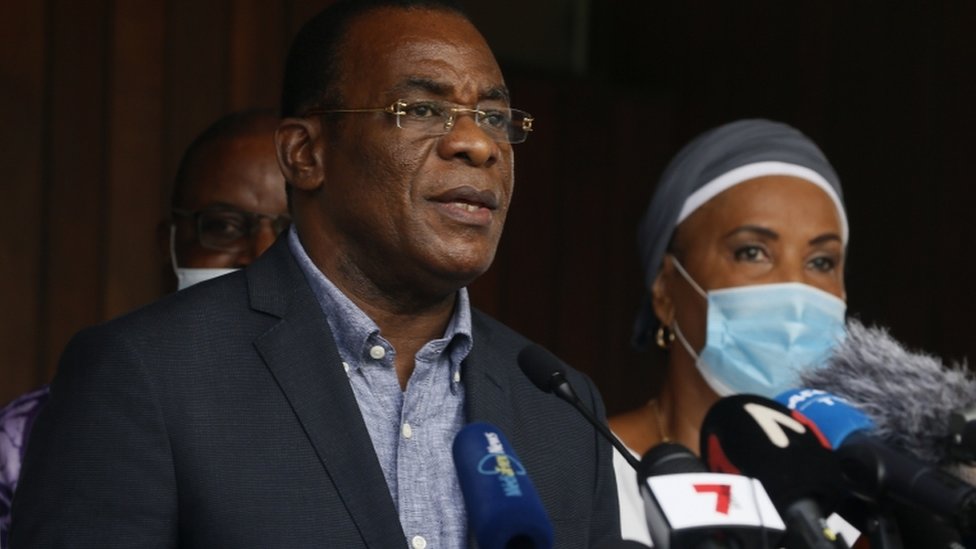
Main opposition candidates Pascal Affi N’Guessan and Henri Konan Bédié had urged their supporters not to vote in Saturday’s poll.
They got 1% and 2% respectively, while a fourth candidate, Kouadio Konan Bertin, also got 2%, according to the official results.
Opposition figures say it was illegal for Mr Ouattara to stand for a third term as it broke rules on term limits.
“Maintaining Mr Ouattara as head of state is likely to lead to civil war,” M N’guessan said, adding that the opposition noted a vacancy of power.
But the president’s supporters dispute this, citing a constitutional change in 2016 which they say means his first term effectively did not count.
His party has warned the opposition against any “attempt to destabilize” the country, which is still recovering from a civil war sparked by a disputed election in 2010.
It has accused the opposition of sedition by calling for a transitional government.
The European Union has said it was deeply concerned about tensions in the country – its foreign policy chief Josep Borrell said incitements to hatred were continuing.
The United Nations refugee agency has said thousands of people have fled to neighbouring countries, fearing more violence.
At least 35 people have been killed in political clashes, which continued on election day.
What happened on Saturday?
The election was marred by intimidation, violence and electoral malpractice, an advocacy group said of findings by independent election group Indigo Côte d’Ivoire.
“An election is the moment when a society comes together to experience and live out democracy, but the context that prevailed on election day… shows that a large segment of the Ivorian population did not experience this election in peace,” PTI Advocacy Group said in a statement.
IMAGE COPYRIGHTAFP
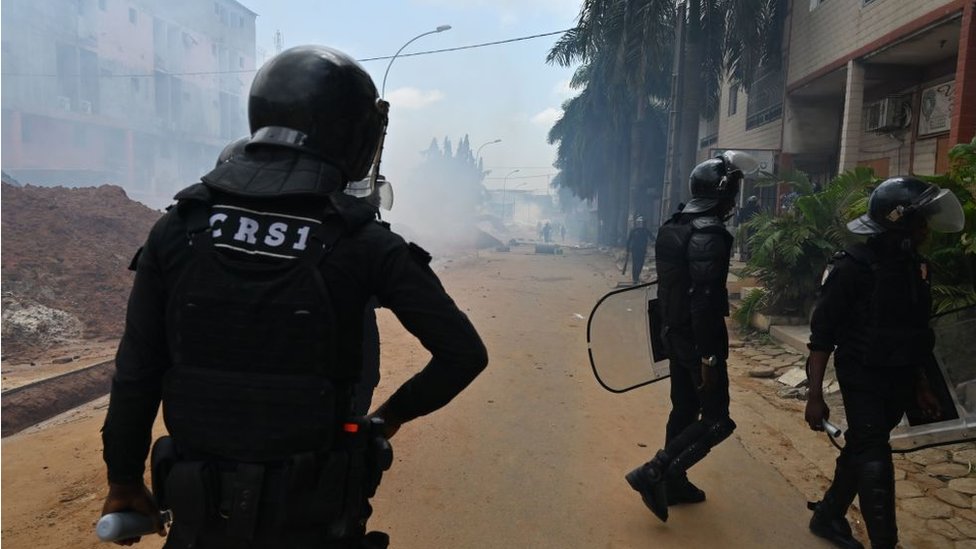
Image caption: Anti-riot police used tear gas to disperse protesters in AbidjanIt added that a significant number of voters were disfranchised because polling stations did not open, adding that even those people who were able to vote did so “in a context of fear and anxiety”.
It said that 23% of polling stations had not opened at all due to threats or attacks, and that in 5% of polling stations, observers reported threats or intimidation of election officials.
IMAGE COPYRIGHTAFP
Image caption: Key opposition figures are urging mass protests to block what they describe as a “dictatorship”
Several polling stations were ransacked in opposition strongholds on Saturday and election materials were burned.
In the eastern town of Daoukro, protesters erected roadblocks. Meanwhile tear gas was used to push away demonstrators who gathered close to where the president cast his ballot in the main city, Abidjan.
What do the authorities say?
The electoral commission head called the disturbances on Saturday “minimal”, saying they “only affected 50 polling stations out of 22,381”.
Some 35,000 security officers were deployed across the country to transport election materials and ensure safety, the security minister said.
IMAGE COPYRIGHTEPA
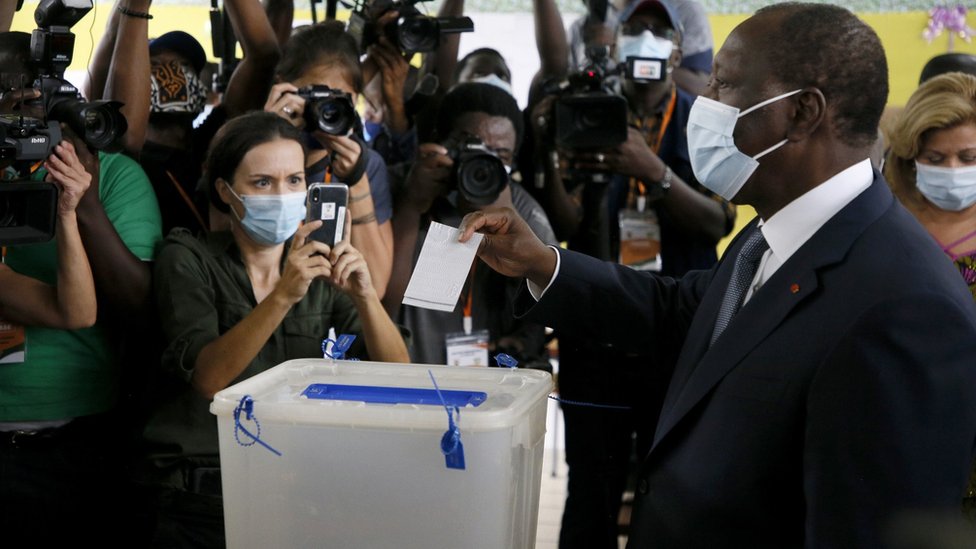
Image caption: President Ouattara had promised to step down after his two terms in office
After voting in Abidjan on Saturday, Mr Ouattara called for an end to the protests.
“I call on those who called for civil disobedience, which led to the loss of life, to stop,” he said.
“They should stop because Ivory Coast needs peace, these are criminal acts and we hope that all this can stop, so that after the election this country may continue on its course of progress, which it has enjoyed over the last few years.”
Why was the election controversial?
According to the constitution, Ivory Coast has a two-term presidential limit. Mr Ouattara – who has been elected twice – initially said he would stand down.
But, in July, the ruling party’s previous presidential nominee, Prime Minister Amadou Gon Coulibaly, died of a heart attack.
Mr Ouattara subsequently announced that he would run for president after all.
His supporters argued that a constitutional change in 2016 reset the clock and that his first term did not count.
His opponents do not share that view, arguing instead that it is illegal for Mr Ouattara to run for a third term.
What’s the background to the tension?
There has been a decades-long quarrel between some of the country’s leading political figures.
In 2010, Laurent Gbagbo, who was president at the time, refused to concede to Mr Ouattara following the election that year. This sparked a bitter civil war.
IMAGE COPYRIGHTAFP
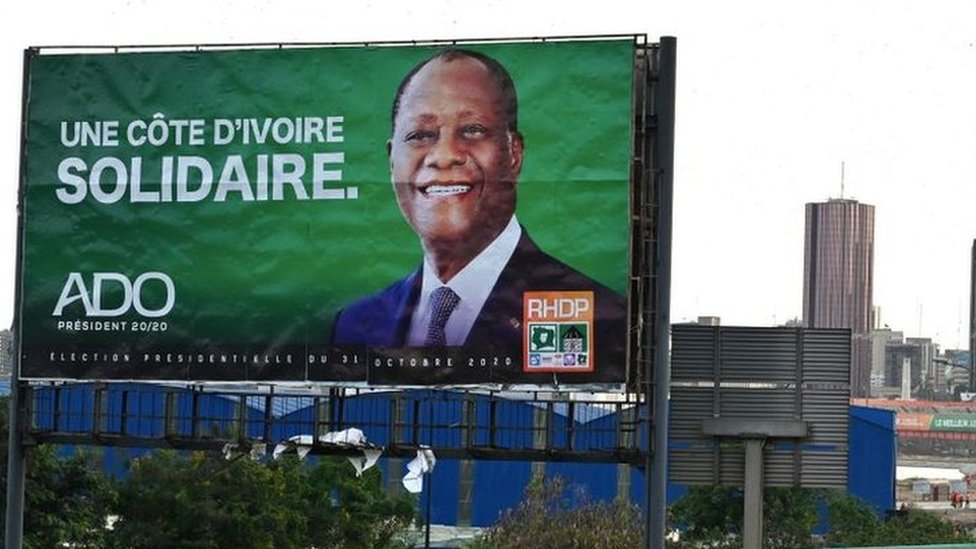
Image caption: Mr Ouattara’s campaign billboard appeals for unity in Ivory Coast
More than 3,000 people were killed in the five months of violence.
Mr Gbagbo also put himself forward to stand in this year’s election but the electoral commission blocked him because he had been convicted in the Ivorian courts.
He was one of nearly 40 potential candidates who were turned down by the commission.
Who were the presidential candidates?
Alassane Ouattara, 78, economist. Became president in 2011, serving his second term after years in opposition. Party: Rally of Houphouëtists for Democracy and Peace (RHDP)
Henri Konan Bédié, 86, career politician. Served as president between 1993 and 1999, deposed in coup. Party: Democratic Party of Ivory Coast (PCDI)
Pascal Affi N’Guessan, 67, career politician. Served as prime minister between 2000 and 2003 under then-President Laurent Gbagbo. Party: Ivorian Popular Front (FPI) faction
Kouadio Konan Bertin, 51, career politician, known as KKB, was once youth leader in the former ruling Democratic Party of Ivory Coast, is now an MP. Independent candidate
After our church meetings, we were back on the road again, this time it took us 8 hours to get home, returning through the same beautiful country we traveled yesterday.
Here are some vendors at a gas station where we stopped to refuel. They were delightful ladies, hoping for a sale. We already had a big bunch of bananas and peanuts as our car food, so we were a disappointing group for these ladies, but we enjoyed visiting with them anyway.
Roasted plantain and peanuts for saleA rest stop by the gas station
Smoked fish
We were in good company as we traveled, with plenty of vehicles around also filled pretty full!




 Our Cote d’Ivoire Abidjan East and Bamako, Mali Mission